

Limoneira Bundle

Who controls Limoneira Company today?
A 132-year-old citrus grower, Limoneira accelerated an asset-light pivot in 2023–2025—selling non-core farmland, reducing debt, and authorizing buybacks—shifting influence among families, insiders, and institutions.

The ownership mix—founder-family stakes, institutional holders, insider positions, and the public float—drives capital allocation, land monetization pace, and governance in this water- and land-intensive agribusiness.
Explore product analysis: Limoneira Porter's Five Forces Analysis
Who Founded Limoneira?
Founded in 1893, Limoneira began as a closely held agricultural enterprise led by Nathan Weston Blanchard and partners from Ventura County’s ranching and oil circles; early control rested with local civic and ranching families who contributed land and capital.

Founding partners
Nathan Weston Blanchard and regional agricultural investors organized the company in 1893, pooling land and subscription capital to plant orchards.
Early leadership
Charles Collins Teague joined soon after founding, later serving as president and shaping operations and governance across decades.
Family networks
The Teague/McKevett family network became central to expansion, with family stewardship dominating board and operational roles in the early 20th century.
Ownership concentration
Initial cap tables were privately held and tied to land contributions; transfer restrictions were common, limiting outside ownership and preserving local control.
Governance culture
Early governance prioritized multi-decade orchard development, water rights security, and land improvements over short-term distributions.
Stake reallocations
Exits and consolidations mainly reallocated equity among Blanchard/Teague-affiliated groups and local backers rather than opening ownership to distant investors.
Period corporate records and regional histories show a closely held ownership structure in Limoneira’s early decades, with board control anchored by founding families and customary buy-sell understandings restricting transfers outside the local syndicate; modern SEC filings do not reproduce precise founding percent allocations.

Key historical facts
Founders and early ownership shaped Limoneira’s long-term trajectory and remain relevant to understanding Limoneira ownership and Limoneira family ownership questions today; see company history and filings for current Limoneira shareholders.
- Nathan Weston Blanchard founded the company in 1893 with local agricultural and oil-associated partners.
- Charles Collins Teague became a pivotal leader and later president, embedding family stewardship.
- Early ownership was closely held, tied to land contributions and capital subscriptions, with transfer restrictions common.
- Founding family networks reallocated stakes internally; precise founding cap-table percentages are not reproduced in modern SEC records.
For context on how historical ownership informs modern strategy and shareholder mix, see the article Marketing Strategy of Limoneira which discusses legacy influence on present Limoneira ownership structure and shareholder relations.
Limoneira SWOT Analysis
- Complete SWOT Breakdown
- Fully Customizable
- Editable in Excel & Word
- Professional Formatting
- Investor-Ready Format

How Has Limoneira’s Ownership Changed Over Time?
Key events shaping Limoneira ownership include its gradual transition from a family-run ranch to a Nasdaq-listed agribusiness (LMNR), progressive broadening of the shareholder base through public offerings, and two decades of rising passive institutional indexation that shifted voting power while founder-family descendants and local stakeholders retained meaningful minority positions.
| Period | Ownership Milestone | Impact on Control |
|---|---|---|
| Pre-2000s | Closely held family and local ranch interests | Founder-family controlling influence over strategy |
| 2000s–2010s | Public listings and gradual share dispersal; one-share-one-vote common stock | Reduced family control; increased retail and institutional float |
| 2015–2025 | Rise of passive investing; institutional accumulation (Vanguard, BlackRock, DFA, State Street) | Institutions hold mid- to high-single-digit stakes each; combined passive often 35–50% of float |
Ownership today blends institutional holders, insiders and legacy family/local stakeholders, and a public retail float; market cap in 2024–2025 commonly sat in the low hundreds of millions, with valuation sensitive to lemon prices, water costs, and land monetization disclosed in SEC filings.
Ownership profile highlights
Major stakeholders shape governance and strategic choices such as debt reduction, selective asset sales, and real estate JV monetizations while preserving agricultural scale.
- Top institutional holders frequently include Vanguard, BlackRock, Dimensional Fund Advisors, and State Street
- Insider holdings: long-serving executives and directors report modest single-digit individual stakes
- Legacy family and local agricultural networks (Kimball-, Teague-linked) remain significant individual shareholders
- Public float provides liquidity but limited coordinated voting power
For detailed historical context and investor interest, see the company overview in Target Market of Limoneira; for up-to-date holdings consult LMNR SEC filings (Form 10-K/10-Q and latest proxy) which list institutional ownership percentages, insider ownership percentages, and material land monetization events through 2024–2025.
Limoneira PESTLE Analysis
- Covers All 6 PESTLE Categories
- No Research Needed – Save Hours of Work
- Built by Experts, Trusted by Consultants
- Instant Download, Ready to Use
- 100% Editable, Fully Customizable

Who Sits on Limoneira’s Board?
The Limoneira board combines executive leadership and independent directors with deep regional agribusiness, water-law and real estate experience; CEO/President Harold S. Edwards serves on the board alongside long-standing local figures and independent financial and operational experts, reflecting Limoneira ownership ties to family legacy and institutional shareholders.
| Director | Role / Expertise | Notes on Voting Influence |
|---|---|---|
| Harold S. Edwards | CEO / President — Executive leadership | Holds officer role; votes as ordinary shareholder under one-share-one-vote |
| Independent Director A | Citrus operations / agribusiness | Independent oversight; represents active governance expertise |
| Independent Director B | Real estate development | Guides monetization strategy for land assets |
| Independent Director C | Water law / resource management | Key for agricultural sustainability and asset value preservation |
| Independent Director D | Finance / audit | Oversees financial controls and shareholder-aligned capital allocation |
Limoneira utilizes a standard one-share-one-vote common stock structure with no disclosed dual-class or super-voting shares in SEC filings through 2025; institutional investors and family shareholders exert influence via share accumulation and proxy voting rather than designated board seats.
Board composition and voting power highlights
Board control tracks share ownership and proxy outcomes; typical shareholder dialogues focus on compensation, capital returns, and land monetization pace.
- Governance: one-share-one-vote — no dual-class or golden shares reported in 2024–2025 SEC filings
- Insiders & family: historic Kimball-family ties and management directors present, but no controlling family stake publicly asserted
- Institutionals: major passive institutions (index funds, mutual funds) are top holders but do not hold designated seats; influence exercised through proxy guidelines
- Proxy activity: no widely reported control-changing proxy battles through 2024–2025; say-on-pay votes and shareholder proposals have shaped compensation and capital allocation
For details on how ownership influences business lines and asset strategy see Revenue Streams & Business Model of Limoneira; recent 2024–2025 SEC 13F and proxy statements list largest institutional holders (Vanguard, BlackRock, State Street among top passive holders) and show insider ownership typically under 5% for individual executives while combined family-related holdings historically provided notable but non-controlling influence.
Limoneira Business Model Canvas
- Complete 9-Block Business Model Canvas
- Effortlessly Communicate Your Business Strategy
- Investor-Ready BMC Format
- 100% Editable and Customizable
- Clear and Structured Layout

What Recent Changes Have Shaped Limoneira’s Ownership Landscape?
Recent ownership trends at Limoneira show incremental concentration among remaining holders driven by asset monetization and a measured buyback program; institutional passive inflows rose modestly while insiders maintained stable aggregate stakes through 2025.
| Metric | 2023–2025 Activity | Impact on Ownership |
|---|---|---|
| Asset sales / deleveraging | Sale of non-core farmland and surplus assets; proceeds applied to reduce net debt and fund buybacks | Increased relative ownership percentages for remaining holders; supported per-share metrics |
| Real estate JV (The Harvest) | Phased lot deliveries with Lewis; capital-light cash flows and NAV realization | Attracted real-asset and event-driven investors as milestones hit; improved institutional interest |
| Institutional mix | Modest rise in passive/index ownership; rotation among value/income managers tied to lemon pricing cycles | Holder base diversified between long-only index funds and event-driven buyers |
| Insider activity | Routine Form 4 filings; no transformational insider purchases/sales through 2025 | Control unchanged; insider ownership percentage stable in aggregate |
| Capital returns | Dividend maintained versus free cash flow; selective buybacks prioritized after debt paydown | Shareholder-friendly stance without material change to control |
Analysts expect additional asset sales or JV expansions could further simplify the capitalization and shift holders toward NAV-focused funds; no dual-class or privatization actions announced through 2025.
 Asset monetization pace
Limoneira completed multiple acreage sales 2023–2025, reducing net debt by a reported over $50 million and enabling a board-authorized repurchase program.
Real estate JV cash flows
The Harvest at Limoneira delivered phased lots beginning 2024, producing recurring capital-light cash flows and incremental NAV realization for shareholders.
Institutional ownership trends
Index inclusion and small-cap ETF flows raised passive ownership to low double-digit percentages by 2025, while active value and income managers rotated exposure based on lemon pricing visibility.
Insider and governance
Aggregate insider ownership remained steady; routine Form 4 disclosures showed no control-shifting trades as of mid-2025.
For context on market positioning and peers see Competitors Landscape of Limoneira
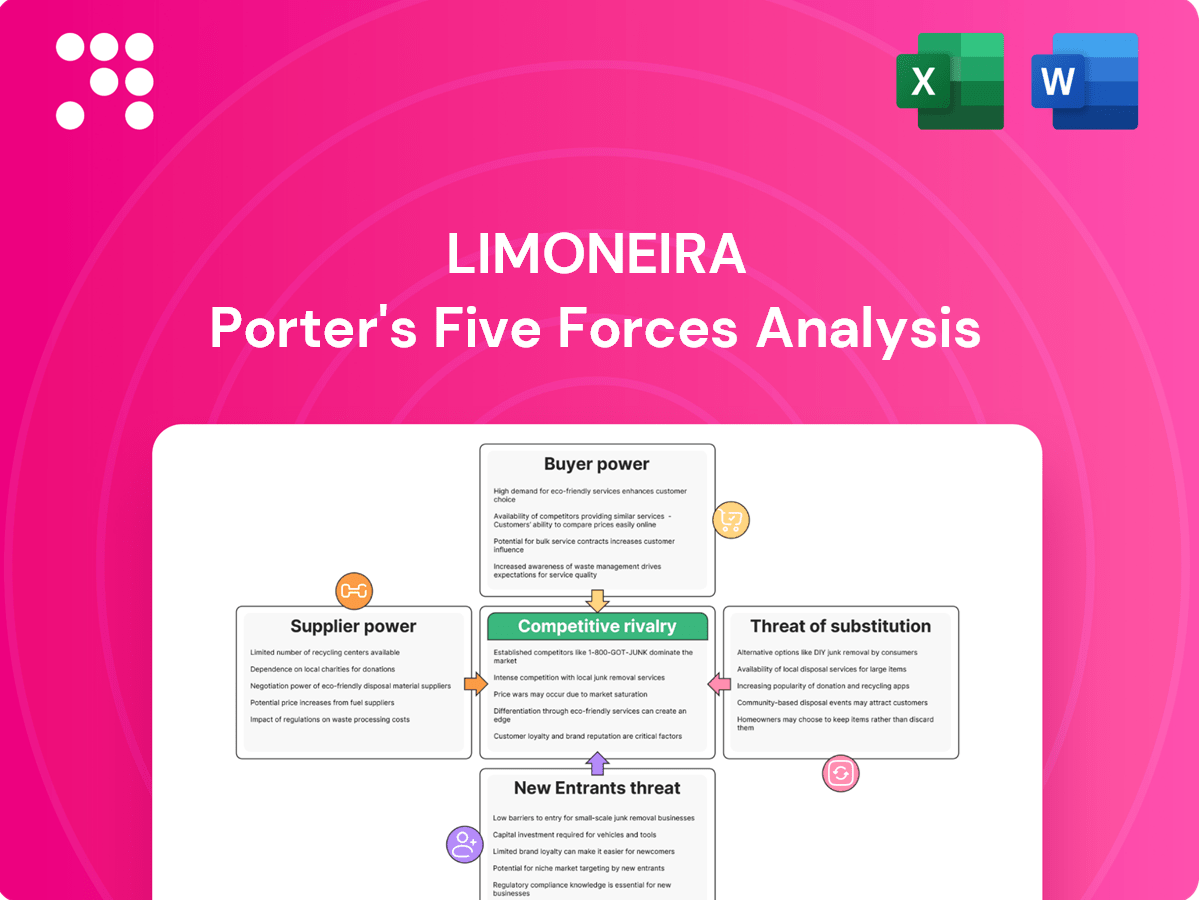
Limoneira Porter's Five Forces Analysis
- Covers All 5 Competitive Forces in Detail
- Structured for Consultants, Students, and Founders
- 100% Editable in Microsoft Word & Excel
- Instant Digital Download – Use Immediately
- Compatible with Mac & PC – Fully Unlocked
- What is Brief History of Limoneira Company?
- What is Competitive Landscape of Limoneira Company?
- What is Growth Strategy and Future Prospects of Limoneira Company?
- How Does Limoneira Company Work?
- What is Sales and Marketing Strategy of Limoneira Company?
- What are Mission Vision & Core Values of Limoneira Company?
- What is Customer Demographics and Target Market of Limoneira Company?
Disclaimer
All information, articles, and product details provided on this website are for general informational and educational purposes only. We do not claim any ownership over, nor do we intend to infringe upon, any trademarks, copyrights, logos, brand names, or other intellectual property mentioned or depicted on this site. Such intellectual property remains the property of its respective owners, and any references here are made solely for identification or informational purposes, without implying any affiliation, endorsement, or partnership.
We make no representations or warranties, express or implied, regarding the accuracy, completeness, or suitability of any content or products presented. Nothing on this website should be construed as legal, tax, investment, financial, medical, or other professional advice. In addition, no part of this site—including articles or product references—constitutes a solicitation, recommendation, endorsement, advertisement, or offer to buy or sell any securities, franchises, or other financial instruments, particularly in jurisdictions where such activity would be unlawful.
All content is of a general nature and may not address the specific circumstances of any individual or entity. It is not a substitute for professional advice or services. Any actions you take based on the information provided here are strictly at your own risk. You accept full responsibility for any decisions or outcomes arising from your use of this website and agree to release us from any liability in connection with your use of, or reliance upon, the content or products found herein.